

The dividend aristocrats list shows an elite group of quality companies. In order to be eligible for inclusion a company must be an S&P 500 member and to have increased annual dividends for at least 25 years in a row.
There are 69 Dividend Aristocrats for 2026
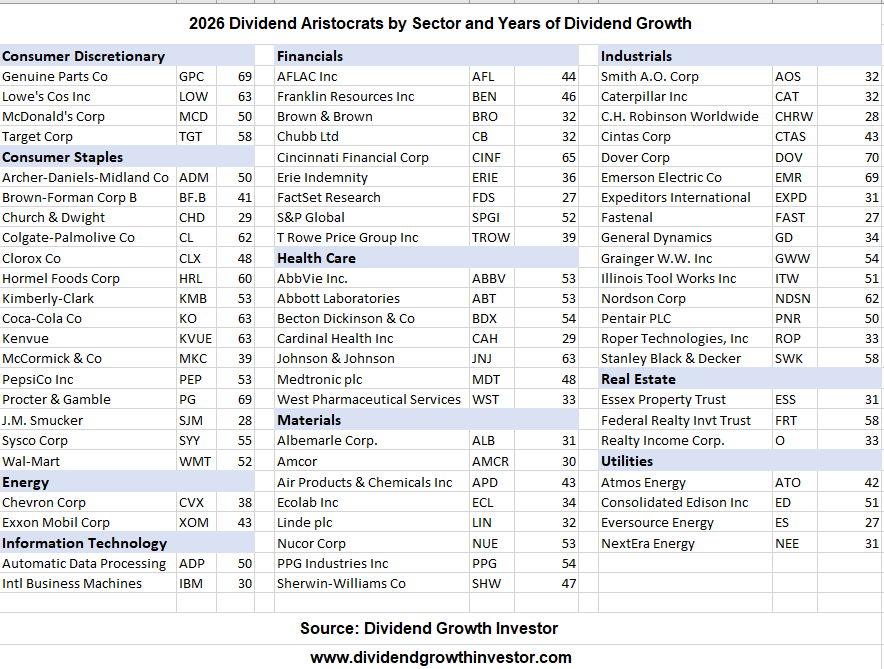
.
I love this list as a potential hunting ground for quality companies to acquire at a good entry price. There are a lot of great companies on the list, with solid competitive advantages, who are leaders in industries that have years of success ahead of them.
Just because a company is a member of this elite list however, doesn’t automatically mean it is a buy.
I like to screen the list, in order to narrow it down to a more manageable group.
In my screen I look at the following:
I review the trends in earnings per share over the past decade. Rising earnings fueld future dividend increases. If earnings do not grow over time, then we have a low likelihood of future dividend growth and growth in intrinsic value.
I review historical dividend growth and most recent dividend increases. Dividends provide a signaling mechanism into management’s assessment of the business and its prospects. I remove slow dividend growth, and lowered recent raises. I want at least a 4% - 5% growth there at minimum, although I also view this in conjunction with yields.
I look at payout ratios that are sustainable, that provide adequate coverage of the dividend and opportunity for some capital to be reinvested. In general, you need margin of safety just in case there. I like the payout ratio to be lower than 60%. However, I could make an exception if a company has a proven track record with payouts remaining high throughout most of that period. There are some utilities that have managed to achieve this, as their business is more stable and less cyclical.
Next, I look at valuation. This involves P/E ratios of less than 25 for me. But I also like to see the combination of dividend yield + dividend growth to be close to 10%. Note, when it comes to dividend growth I compare the scenario where we use most recent dividend increase to the scenario where we use the 5 year annualized average.
I present below a list of 18 Dividend Aristocrats for further review: